
Today we are back with Egyptian Arabic conversation 30.
In each Conversations post, we will provide you with:
- a screenshot from an actual conversation between two Egyptians
- the translation of each line of text, including English, Franco and Arabic script
- context on the conversation and further explanation
We think learning Egyptian Arabic from actual, authentic conversations between Egyptians is both fun and effective. We hope you like it too!
Let’s get started with Egyptian Arabic Conversation 30: Dahab.
Egyptian Arabic Conversation 30: Dahab
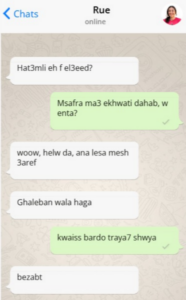
Conversation #30 happens between two friends talking about what they are doing for Eid (the holiday after Ramadan ends).
Here is the screenshot:
Before diving into Conversation 30, check out our guide to reading Franco-Arabic (what the numbers that Egyptians write actually mean).
This makes it a lot easier to read the transliteration of each phrase below.
Egyptian Arabic Conversation 30: Translation
Below you will find a full translation of the entire WhatsApp conversation, along with voice notes for each line.
Keep in mind, this is a conversation between a man (Ahmed, the messages in the white) and a female (Rue, the messages in the green).
What are you going to do in Eid? : Hat3mli eh f el3eed?
هتعملي ايه في العيد؟
Traveling with my siblings to Dahab, and you? : Msafra ma3 ekhwati dahab, w enta?
مسافرة مع اخواتي دهب، وانت؟
Wow, that’s cool, I still don’t know. : Woow, helw da, ana lesa mesh 3aref.
.واااو، حلو ده، انا لسه مش عرف
Probably nothing. : Ghaleban wala haga.
.غالبا ولا حاجة
Also cool to rest a little. : Kwaiss bardo traya7 shwaya.
.كويس برضه تريح شوية
Exactly. : Bezabt.
.بالضبط
Egyptian Arabic Conversation 30: Important Vocabulary
What are you (fem.) going to do… : Hat3mli eh…
…هتعملي ايه
This is a good example of the future tense in Egyptian Arabic.
You basically just do two things:
- conjugate the verb in the present tense (without the ب / “b” letter)
- add the ه / “h” letter to the beginning
Eid. : El3eed.
.العيد
The holiday after Ramadan ends.
Traveling. : Msafra.
.مسافرة
Sometimes in Egyptian Arabic, the present continuous tense (verb + -ing) is shown by the letter م.
Dahab. : Dahab.
.دهب
Located on the southeast coast of the Sinai Peninsula, Dahab is absolutely one of my favorite places in Egypt.
Notice from the conversation that this sentence has know “to” (I am traveling “to” Dahab).
It’s literally “traveling with my siblings Dahab.”
I (masc.) still don’t know. : Ana lesa mesh 3aref.
.انا لسه مش عرف
This is an example of a time when you could make a mish sandwich, but in which you don’t actually have to.
What I mean here is that there are two ways to negate verbs:
- Make a mish sandwich by putting the verb in between the two letters of mish : m3arefsh / معرفش
- Or as in this case, DON’T do that, and just say ‘mish” before the verb: mesh 3aref / مش عرف
Nothing. : Wala haga.
.ولا حاجة
Wala haga is also a common answer if somebody asks you “What are you doing?”
Exactly. : Bezabt.
.بالضبط
I remember when I was learning Modern Standard Arabic, this was pronounced as “bell-thdubt.”
And then switching to Egyptian Arabic, it become much easier!
Context + Further Explanation
There are a a few common things that Egyptians do during Eid after Ramadan.
Traveling is common, and also just seeing family is a big one.
Check out this video for more background.
…
Happy learning,
Cleo Lingo