
Today we are back with Egyptian Arabic conversation 26.
In each Conversations post, we will provide you with:
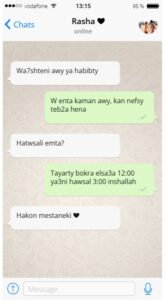
- a screenshot from an actual conversation between two Egyptians
- the translation of each line of text, including English, Franco and Arabic script
- context on the conversation and further explanation
We think learning Egyptian Arabic from actual, authentic conversations between Egyptians is both fun and effective. We hope you like it too!
Let’s get started with Egyptian Arabic Conversation 26: Habibty.
Egyptian Arabic Conversation 26: Habibty
Conversation #26 happens between a man (the text in the white) and a woman (the text in the green).
Here is the screenshot:
Before diving into Conversation 26, check out the following posts about love in Egypt:
- How To Flirt In Egyptian Arabic (Love In Egypt: Part 1)
- How To Go On A Date In Egyptian Arabic (Love In Egypt: Part 2)
- How To Break Up In Egyptian Arabic (Love In Egypt: Part 3)
These will give you some useful context for the rest of this article.
You can also check out our guide to reading Franco-Arabic (what the numbers that Egyptians write actually mean).
Egyptian Arabic Conversation 26: Translation
Below you will find a full translation of the entire WhatsApp conversation, along with voice notes for each line.
(Sorry about the static sounds in a few of them, something got messed up in the download.)
MAN: I missed you so much my sweetheart. : Wa7shteni awy ya habibty.
.وحشتيني قوي يا حبيبتي
WOMAN: You too so much, I wish you were here. : W enta kaman awy, kan nefsy teb2a hena.
.وانت كمان قوي، كان نفسي تبقى هنا
MAN: When will you (fem.) arrive? : Hatwsali emta?
هتوصلي امتى؟
WOMAN: My flight tomorrow is at 12:00 that means I will arrive at 3:00 God-willing. : Tayarty bokra elsa3a 12:00 ya3ni hawsal 3:00 inshallah.
.طيارتي بكرة الساعة 12 يعني هوصل 3:00 ان شاء الله
MAN: I will be waiting for you. : Hakon mestaneki.
.هكون مستنيكي
Egyptian Arabic Conversation 26: Important Vocabulary
I missed you so much. : Wa7shteni awy.
.وحشتيني قوي
This is one of the most common ways to say “I love you” in Egyptian Arabic.
The literal meaning is something like “You made me really bad.”
Kind of cute. 🙂
My sweetheart love (feminine). : Habibty.
.حبيبتي
This is a very common word in Arabic.
Egyptians use it for friends too. But in this conversation it’s likely between lovers.
Keep in mind that there are two ways to say this word:
- Men = habibi / حبيبي
- To women = habibty / حبيبتي
(Although people will often say “habibi” for women as well.)
You too so much. : W enta kaman awy.
.وانت كمان قوي
This is how you say “I miss you too.”
Keep in mind, if you were saying this to a woman, it would be:
W enti kaman awy. / .وانتي كمان قوي
I wish you were here. : Kan nefsy teb2a hena.
.كان نفسي تبقى هنا
Literally: “Was I want you be here.”
A bit weird as a translation.
When will you arrive? : Hatwsali emta?
هتوصلي امتى؟
This is a simple question that uses the Egyptian Arabic future tense.
My flight tomorrow is at 12:00 that means I will arrive at 3:00 God-willing. : Tayarty bokra elsa3a 12:00 ya3ni hawsal 3:00 inshallah.
.طيارتي بكرة الساعة 12 يعني هوصل 3:00
Long sentence but you get the idea.
(Take some time to learn how to tell the time in Egyptian Arabic, it’s one of those “fundamental” parts of the language.)
Important note: as you can see here, the numbers are written in Roman digits (12 + 3).
This is a pretty common thing in Egypt.
God-willing. : Inshallah.
.ان شاء الله
Inshallah is one of the most common phrases in Egyptian Arabic.
Make sure you learn how to use it!
I will be waiting for you. : Hakon mestaneki.
.هكون مستنيكي
This I require a bit of explaining. Let’s break down the two words:
- The future tense of the verb “to be”: hakon / هكون
- The progressive form of “to wait”, but specifically when waiting for a female: mestneki / مستنيكي
For this last one:
Sometimes you add the letter meem / م at the beginning of the verb to express the present progressive (“-ing” verbs in Egyptian Arabic). This isn’t common in Egyptian Arabic, but mestne is one of the times it happens.
As for the -ki / كي at the end of the verb?
This shows that the speaker is talking directly to a woman (“you” feminine).
Context + Further Explanation
This conversation is pretty straightforward.
From the context it is likely a man and a woman that are either dating or married, and her flight arrives tomorrow. Let’s hope he picks her up though-
Getting a taxi from the Cairo airport can be pretty chaotic!
…
Happy learning,
Cleo Lingo